Articles for February 2009
Men gotta do what men gotta do
1 January 2009

La semaine dernière, alors qu’il pleuvait des cordes sur la résidence familiale, on a décidé de démarrer le bbq. En fait, c‘était déjà prévu, avant les cordes, mais cette chute de verglas et tout le tralala n’ont pas arrêté notre lancée, un bbq a bel et bien eu lieu, che nous, le 27 décembre 2008.
Le grill en question, ce monument de pierres érigé par le patriarche dans la cour arrière il y a déjà quelques années, fut déglacé (au sens non culinaire) et déneigé à coups de pelle. On lui a fait un lit de demi-bûches, question de se distancer de l’amovible strate de glace tapissant son fond, et, avec le bois de chauffage bien sec, ça s’est enflammé dans le temps de le dire. Le parapluie fut posé après l’Xe essai de redémarrer le brasier initialement si bien parti; la pluie, coriace et taquine, a néanmoins su tenir son bout.

On a cuit des steaks épais comme ça ↑, des saucisses de boeuf de la ferme d‘à côté et tout plein de légumes d’hiver en papillotes. Après tous les efforts de stabilisation de la braise et des nuisibles contre-attaques verglacées, je salivais comme nul autre. Les steaks, grass-fed, tendres et cuits à point, furent dévorés avec l’enthousiasme d’un passionné, mais surtout d’un affamé. Les papilles à jeun — n’ayant rien mangé depuis le début de l’après-midi —, tout goûte tellement meilleur.
Chalet
4 January 2009
Wo zou le
6 January 2009
Je pars dans moins de quelques heures pour le l’Empire du Milieu.
I still can’t really grasp the scope of it.
Got myself a 16gb sdhc card to store ridiculous amounts of photography. The camera indicates 7.4k photos available.
Comme mentionné ultérièrement, l’itinéraire se déssine grossièrement comme
Montréal > Beijing > Xi’an > Chengdu > Shanghai > Beijing > Montréal.
Avec des à côtés soupoudrés un peu partout.
Less is more: 1 pair of jeans.
Wǒ zǒu le = Je suis parti.
China 1: Ramblings & Landing it
12 January 2009

I’ve been dreaming profusely lately each night, hitting the pillow with enough momentum to last till sun rise, sleeping 9h straight without a peep. No matter the dream, the best part is waking up and realising that you’re still in China.
It took me a few days to reconcile myself with the fact that I’m here for 2 months. Partly (or mainly) because feeling very ill on day two (don’t worry, 18h of sleep cures anything), thus being sickeded by any odd and unusual smell my nose came across: a plague to any new, smell-aware and somewhat sick traveller. Initially disgusted, the olfactive experience is now getting richer by exposure, subltle nuances in the tones let you distinguish the smells and I’m now taking joy in appreciating its spectrum.

Food is definitely tying this trip around as I’m now anxiously awaiting every corner for a new gustative experience. My appetite is being rewarded with ingenious meals that are miles away from the western hues. Street food is high on the list as it is traditionnal, local and very impromptu: the sponteineity of grabbing a bite full of flavor, freshness and flavor, topped with inexpensiveness (one can easily feast for a few dollars a day) is embraced every time, even when you’re not looking for something to eat. Breakfast is always a fun hunt as morning cravings aren’t always the most easy to please. But after tasting many different in Xi’an, the current first place title holder is jian bing guo zi, a hot, folded pancake/omellette with onions and ham.
Currently in Chengdu, Sichuan, land of spicy food and ironic climate dispositions: Hey, its warm here! 10 degres outside! Hurray! But wait, it’s cold! 10 degrees inside! Gawd.
China 2: Chinese Medecine Check-Up
13 January 2009

En tâtant et écoutant mon poul, le docteur chinois me dit que ma santé physique est bonne, mais ma santé mentale est perturbée: je ne suis pas en paix, il y a trop de pensées et d’agitation dans ma tête. Ça doit être l’air de Chine.
China 3: Chinese tourists at Terracotta Warriors, Xi'an
14 January 2009

Nous sommes minoritaires en tout temps, même parmi les touristes.
China 4: Bikes everywhere, even on the runway
15 January 2009

China 5: Pink Dragon
16 January 2009

China 6: 'Tis the season to be orange
17 January 2009

As of mid-january, all over China, the current fruit in season is oranges. In every fruit market, kilos and kilos of oranges and mandarines are showcased in every stall. Later this spring, the pineapples will adorn the streets; grapes and watermelon get their spotlight in the summer. Cute (kè‘ai) little mandarines are smaller yet juicier and sweeter than ever:

China 7: Custom 10 pack
18 January 2009

Got at a local depanneur in Qingcheng, 65km north of Sichuanese capital Chengdu. The clerk takes the initiative of tying single bottles of Snow (one of the local lagers) and making 10 packs for customers to buy. Paid a whopping 30 kuai, which comes down to less than 6 dollars.
China 8: Breakfast on rubble
19 January 2009
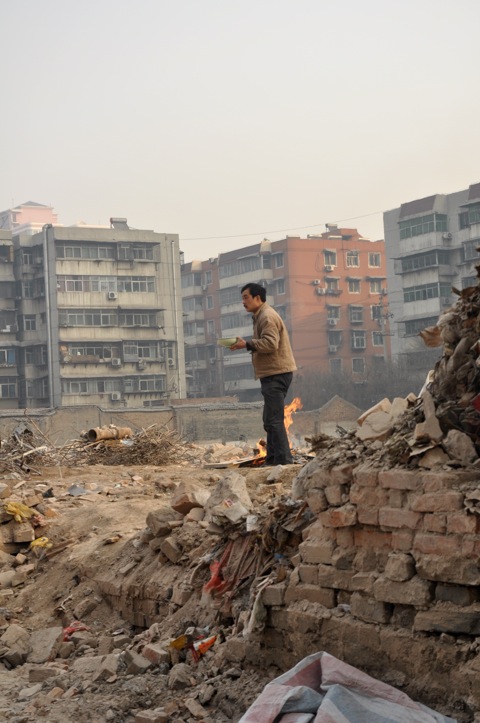
En Chine, tu peux croiser des Mercedes de l’année conduites par des jeunes bourgeoises de 18 ans, des hôtels 5 étoiles avec des noms français pour faire plus chic, les boutiques Louis-Vuitton, Prada et autres marques de désirs absurdes qui brillent sur le grand boulevard (da jié), puis tourner le coin de rue et voir un gars qui déjeune, sans soucis, sur un vieux tas de briques, se réchauffant en brûlant des déchets de construction. J’en ai bien d’autres pour vous.
China 9: Tofu
20 January 2009

Boy, was I gullible. Back home in North America, it is too often said: “Oh, tofu only tastes what you season it with, on its own it has no flavor.” To that, my western friends, I answer: no deal. I have now travelled and tasted tofu, real tofu, and I testify in its favor for it has flavor, flavor perceptible no matter the garnish or sauce. It doesn’t taste something or anything, it tastes like tofu.

As we’ve been going throught every local speciality of Sichuanese’s cuisine—over the top hot and spicy are the keywords here—, my current favorite is ma po dou fu: tofu cubes in an oily red hot spicy peppery sauce. As you can guess, no matter how spicy the sauce, you can still taste the tofu. The texture of the fresh kind—the good kind, made and bought daily at the market—lies somewhere between firm and soft, holding itself together betweeen the baguettes, while melting deliciously in your mouth. Quite the opposite of the sterile brick of blandness found chez nous.
New best breakfast: steamed warmed baozi (puffy and soft little stuffed breads), dipped in warm fresh soy milk.


China 10: I'm in China and I like pandas but this is nevertheless the only panda picture you're gonna get
21 January 2009

Or that I will allow myself to post. A few seconds later, the right one bonked the left one’s head with the bamboo log. Anything cute and mildly violent is funny.
China 11: Taoist monk
22 January 2009

Taoist monk overlooking the valley on Mount Qingcheng (Qīngchéng Shān), 65km north of Chengdu, Sichuan, known as the birthplace of Taoism. Although a few temples and buildings scattered on the site were in pretty bad shape after May’s earthquake, the pagoda at the top of the mountain (1 280m) was standing firmly in place, still hosting readings and meditations.
China 12: Flying Pigeons
23 January 2009

If I had room for a 3rd bike at home (let alone room in my luggage), I would bring one of these Flying Pigeons to Montreal with me, converting it to a stylish fixie for sunday rides in the plateau.
These bad boys have been in production since Mao took over in the early 50s, and are still manufactured today, with the same all-steel frames, the covered chain, sprung leather saddle and old school rod brakes. Though a exponentially growing number of chinese are trading two wheels for four, you can still see many of these riding the streets, mostly by old men, somewhat of a souvenir of a forgotten era now clashing with the decor of today’s contemporary China.
In China, I saw them priced new at around 480 RMB (CDN 95$) and you can probably get a well-used one for less than 100 RMB (CDN 20$). Flying Pigeon NYC and Flying Pigeon LA are selling some in America.
China 13: Sain de corps, sain d'esprit
24 January 2009

There’s an old chinese saying—probably that Confucius again—that goes: “Who walks a hundred steps after each meal will live to see its hundredth birthday.”
This wisdom of personal health and equilibrium can be perceived among the daily routines of many Chinese and the more I look into it, the more it seems to also tie itself to many other cultural traits (e.g. the importance of family, the community, natural harmony), which then all trickle down to basic common ideas of chinese philosophy.
It is then no so surprising then to find that the many parks scattered across the cities are places of physical and communal activities of all types. With more time of their hands, the elderly accompanied by their grand-children are probably the most active, present at sunrise or after sunset practicing tai-chi together, dancing routines or stretching exercises or also more sportive games like ping-pong, badminton or aki. It is heart warming to see these gatherings as more than mere workouts but also occasions to meet and be with others; and none are restricted nor limited, free to come and go as you may, everybody’s welcome.

The most surprising element—which clearly confirms how deep these habits are rooted in the chinese culture—is how parks now provide outdoor exercising machines, free of use by anyone. These straightforward machines work out many different muscles, allowing its users (again, a lot of elderly) to move, stretch and sweat a bit. We’ve seen many in city parks but in rural areas as well. Here are a few of them:


Tried them all and the most fun is the foot swinger, ‘tis like walking on air. All pimpled yellow plastic pieces are mostly to massage the muscles. And there were many more, including stationary bikes and a revolving stretching disc.
China 14: Shanghai housing project
25 January 2009

Shanghai is full of these. Über-dense, dense, dense. And there building more all over the place. Yet once in it, the city doesn’t feel as monstrous (in a nice, gentle giant kind of way) as it first looks.
China 15: Xin nian kuai le
26 January 2009

Which translates in New Year Happy in Chinese. The year of the ox started today and for the next two weeks, China is on hiatus. Spring Festival as it is also called is “one of the most important traditional holidays” with many celebrations and rites through out the next 15 days.
So, to start of this new year on the right foot, to scare off any ghouls and other evil spirits, why not a few free-for-all, lawless hours of uproar, firecrackers-a-bamming and fireworks-a-kabooming? From early on yesterday evening to late in the night, it was Beirut-style in Shanghai, everything was blasting off anywhere and everywhere, hitting an apogee of light and sound at the turn of the new year. As the evening went on, smoke was accumulating and by 1 AM, it was as if a heavy fog had taken over the city skyline, silhouettes of the neighboring residential towers striking through the smoke as fireworks still blasted nearby.

Yours truly gazing at the explosions, a mere 30 feet of the apartment window. BAM. Comme mon père dirait, “c’est un vrai Capharnaum.” (Photo crédit: Miss Bélanger)
China 16: East Nanjing Street, Shanghai
27 January 2009

BAM! Welcome to Shanghai. Right across from the large park at the center of the City is Nanjing Xi Lu (East Nanjing Street), that reaches east to the Bund on the river front. It’s kind of like the shopping strip on St-Catherine St. in Montreal, only much longer, denser, pedestrian-only [and full of Chinese]. Felt a lot like Times Square at times, with high-end boutiques, a few hotels, a Häagen Dazs restaurant (the love ice cream here, even at 0°C) and countless Nike stores.
China 17: Waterborne calligraphy
29 January 2009


Seen in Fuxing Park, French Concession, Shanghai. Two young guys, maybe late 20s early 30s, with brushes and a bucket of water, writing the stones away. Contemporary asian culture magazine Theme has an article on the topic:
“Calligraphy is not just a skill, or even an art. It is also a philosophical thing, a ritual and a lifestyle. The intentionality of a calligrapher is often not just to make an object, or a work of art such as an oil painting or a sculpture. More exactly, the calligrapher is having a silent dialogue with himself and experiencing the subtle pleasure of discovering himself through the movement of the brush and his own body. The process of making calligraphy is more important than the product of calligraphy.”
China 18: Flat Patterns, Shanghai
30 January 2009

If you know a bit about recent Chinese/Shanghai’s architecture, you should be able to guess the name of the tower in the center of the photo. Hint: Pudong.
China 19: Pudong, Shanghai
31 January 2009

Pudong, the East side of the Huangpu river that crosses Shanghai, has skyrocketed from farmland to skyscrapers in less than 20 years. The city district holds a sub-provincial administrative status, which has been defined as to become mainland’s China most important financial and commercial hub. Settled to attract foreign investments, construction and planning started in the early 90s and Pudong today hosts a world class skyline which, by the way, is still growing.

The latest addition to the financial Lujiazui district is the Shanghai World Financial Center with its roof hitting 492m, the tallest building of China (including Hong Kong), and the second-tallest in the world. And the original planning asks for another über-tower. So, the Shanghai tower was annouced to crown the district, hitting 632m (thus surpassing the taiwanese by far) with completion originally planned in time for the 2010 expo, but delays delay, construction started only very recently, unfortunately it won’t be done till 2014.


In the big blue empty space on the right, imagine the 128 story tall, slick glass facade skyscraper, twisting on itself as it rises, its skin curled towards the sky. Something like this.

China 20: Around the Bund, Shanghai
1 February 2009

Shanghai often has this NYC vibe, with juxtapositions of old 19th century buildings, 20th century towers, tangled aggregation of electric wires, swarming crowds of people rushing, whiffs of curiously bad smells, taxis honking and street food vendors yelling. Fun!